
Path 1
Start Here
Your next draft starts here.
Try a topic, assignment type, or skill.
Starting an essay
Move from prompt to plan to draft.
Planning an outline
Use the fillable organizer before drafting.
Stuck on evidence
Introduce, quote, cite, and explain support.
Research or citations
Open databases and check MLA or APA.
Science CER writing
Build a claim, evidence, and reasoning response.
College essay work
Plan, draft, and revise a personal response.
AI expectations
Check what is allowed before using AI.
Presentation prep
Organize a talk and make stronger slides.
Teacher Quick Links
Common classroom handouts.
Open the resources students ask for most often.
Recommended Paths
Follow the route that matches your draft.
Choose a starting point, then move through the linked steps in order.
Path 2
My essay needs stronger body paragraphs.
Path 3
I am writing for science.
Path 4
I need research, citations, or style help.
Path 5
I am working on a college essay.
Path 6
I am preparing to present.
College Essay Resources
College essay planning
Use these resources to brainstorm, plan, draft, and revise college essay responses.
Planning
College Essay Planning Sheet
Use this student planning sheet to gather ideas, shape a focused response, and prepare for drafting a college essay.
Open College Essay Planning Sheet PDFDrafting
Writing Your College Essay
Use this guide to understand the purpose, structure, and drafting moves that help shape a strong college essay.
Open Writing Your College Essay PDFExamples
Johns Hopkins - Essays That Worked
Read sample college essays and reflections from Johns Hopkins to see how successful applicants shaped personal stories.
Open Johns Hopkins EssaysExamples
Connecticut College - Essays That Worked
Read successful Connecticut College essay examples to study voice, reflection, focus, and personal storytelling.
Open Connecticut College EssaysEthical Use of AI
AI use guidance
Use these resources to understand when AI support is allowed, limited, or not appropriate for school writing.
AI Guidance
WHS AI Stoplight Framework
Use the WHS stoplight framework to check expectations for acceptable, limited, and prohibited AI use before beginning an assignment.
Open WHS AI Stoplight Framework PDFAI Guidance
Wolcott Public Schools AI Guidelines
Use the district AI guidelines to understand expectations for responsible, ethical, and school-appropriate AI use.
Open Wolcott AI Guidelines PDFFormatting and Style Guides / WHS Databases
Formatting and research links
Start here for citation style guides, formatting help, and WHS research resources.
MLA
MLA - Purdue OWL
Use Purdue OWL for MLA formatting basics, in-text citation help, Works Cited guidance, and sample paper expectations.
Open Purdue OWL MLA GuideMLA
MLA Style Center
Use the official MLA site for style questions, citation guidance, sample papers, teaching resources, and updates from MLA.
Open MLA Style CenterAPA
APA Style
Use the official APA Style site for APA formatting, citation rules, reference examples, bias-free language, and student paper guidance.
Open APA StyleWHS Databases
WHS Databases with Passwords
Use this WHS database handout for database links and access information. School network access may be required.
Open WHS Databases PDFOrganizing Templates
Essay planning documents
Open one of these copy-ready Google Docs when you want a clean planning page or a sample structure to follow. Teachers can also use the completed organizer below as a presentation-ready model.
Organizer
General Essay Graphic Organizer
Open a copy-ready planning document for building a full essay from question through conclusion.
Open General Essay Graphic OrganizerOutline
Sample Essay Outline
Open a copy-ready outline that shows a clean sample structure for organizing an academic essay.
Open Sample Essay OutlineCompleted Example
General essay graphic organizer
This embedded version is for modeling and discussion. Students should use the Google Doc button above when they need a fillable organizer.
Essay Question
Should schools require students to complete community service before graduation?
Introduction Paragraph
Set up the essay.
Hook
Grab the reader's attention and introduce the question topic: quote, statistic, fact, or statement of theme.
Every year, students learn some of their most important lessons outside the classroom by helping people in their communities.
Background Information
Provide necessary and relevant details for context. Who? What? Where? When? Why? How?
Many high schools encourage service because it helps students practice responsibility, empathy, and civic participation while responding to real needs around them.
Thesis Statement: First Draft
Answers the question: subject + position + reasons why.
Schools should require community service because it helps students build character and support others.
Thesis Statement: Final Draft
Revise for clarity, specificity, and connection to the prompt.
High schools should require community service before graduation because it builds responsibility, strengthens empathy, and connects students to local needs.
Body Paragraph #1
Build the first reason.
Topic Sentence / Claim
Introduce the main idea of the body paragraph and connect back to the thesis.
Community service helps students develop responsibility by requiring them to follow through on real commitments.
Evidence and Citation
Use specific facts, quotes, stats, descriptions, or explanations from resources. Embed evidence and cite it properly.
According to one source, students who volunteer must arrive on time, complete assigned tasks, and work with others to meet community goals (Smith 12).
Explanation / Analysis / Reasoning
Explain how the evidence supports your position. Elaborate and connect back to the thesis.
This supports the thesis because service gives students practice with expectations that matter beyond school, such as being dependable and completing work that affects other people.
Concluding Sentence
Summarize the main point and remind the reader of your position or argument.
For this reason, required service can help students become more responsible members of their school and community.
Body Paragraph #2
Build the second reason.
Topic Sentence / Claim
Introduce the main idea of the body paragraph and connect back to the thesis.
Service requirements can also strengthen empathy because students work directly with people whose experiences may be different from their own.
Evidence and Citation
Use specific facts, quotes, stats, descriptions, or explanations from resources. Embed evidence and cite it properly.
The article explains that students who volunteer at food banks, shelters, or tutoring programs often gain a better understanding of the challenges people face in their town (Lopez 4).
Explanation / Analysis / Reasoning
Explain how the evidence supports your position. Elaborate and connect back to the thesis.
This matters because empathy grows when students move beyond reading about problems and actually see how their actions can help another person.
Concluding Sentence
Summarize the main point and remind the reader of your position or argument.
As a result, required service can make students more aware, compassionate, and connected to the people around them.
Body Paragraph #3
Build the third reason.
Topic Sentence / Claim
Introduce the main idea of the body paragraph and connect back to the thesis.
Finally, community service connects students to local needs and shows them that they can make a practical difference.
Evidence and Citation
Use specific facts, quotes, stats, descriptions, or explanations from resources. Embed evidence and cite it properly.
One school reported that student volunteers helped collect supplies, clean public spaces, and support younger students through after-school programs (Chen 8).
Explanation / Analysis / Reasoning
Explain how the evidence supports your position. Elaborate and connect back to the thesis.
These examples show that service is not just an assignment; it gives students a role in solving real problems and improving shared spaces.
Concluding Sentence
Summarize the main point and remind the reader of your position or argument.
By connecting students to local needs, service requirements help schoolwork feel more meaningful and useful.
Conclusion Paragraph
Bring the essay to a close.
Conclusion Paragraph
Include a transition, reemphasize the main points without introducing new information, and end with a call to action.
In conclusion, high schools should require community service because it builds responsibility, strengthens empathy, and connects students to real needs. When students serve others, they learn that their choices can improve their community. Schools should give every student the chance to practice that kind of citizenship before graduation.
Essay Writing Central
The writing process
Use these steps to move from prompt to polished response in any subject area.
Step 1
Understand the Task
- Identify the type of writing, such as argumentative, explanatory, analytical, narrative, descriptive, lab report, or reflection.
- Determine the audience and purpose: inform, persuade, explain, reflect, or analyze.
- Highlight or annotate key parts of the prompt or question.
- Note discipline-specific requirements, including evidence, citations, technical vocabulary, and formatting.
Step 2
Plan the Writing
- Brainstorm or mind-map ideas related to the topic.
- Create a working thesis for longer essays or a claim for single-paragraph responses.
- Outline key points or paragraphs.
- Identify evidence, examples, or data to support each point, such as quotes, experiments, historical facts, or mathematical reasoning.
- Use a graphic organizer for reports, compare-and-contrast writing, or cause-and-effect writing.
Step 3
Draft the Response
Introduction
- Hook
- Background information or context
- Clear and specific thesis statement
Body Paragraphs
- Begin each paragraph with a topic sentence that makes a claim connected to the thesis.
- Support the claim with relevant evidence and reasoning.
- Include discipline-appropriate analysis, such as interpretation, calculations, comparisons, or reasoning.
- Use transitions to maintain flow.
- End with a concluding sentence.
Conclusion
- Restate the thesis in a new way.
- Synthesize key points.
- End with a concluding thought or implication when relevant.
Step 4
Revise for Clarity and Content
- Does the writing clearly answer the prompt?
- Are ideas organized logically?
- Is the evidence accurate and relevant?
- Are discipline-specific conventions followed, such as citations, scientific terminology, or historical context?
- Are transitions smooth between ideas?
Step 5
Edit
- Proofread for grammar and punctuation.
- Check sentence structure and clarity.
- Review spelling and word choice.
- Confirm consistent formatting, such as MLA, APA, or lab format.
- Check citations and the works cited page or bibliography when required.
Step 6
Submit or Share
- Double-check the rubric or assignment checklist.
- Make sure all parts of the assignment are complete.
- Include name, date, and the proper heading or format.
- Confirm the submission method, such as Google Classroom, Turnitin, or paper copy.
Subject-Specific Considerations
Adjust the process for the class.
English: Literary analysis, rhetorical devices, and narrative craft.
History: Primary and secondary sources, historical context, persuasive evidence, and arguments.
Science: Claim-evidence-reasoning, lab reports, and technical writing.
Math and CTE: Logical reasoning, explanation of steps, and real-world application.
Art and Music: Reflection, critique, and explanation of creative choices.
World Language: Vocabulary, grammar patterns, cultural context, and clear communication.
Essay Writing Central
Writing an effective introduction
A strong introduction engages the reader, identifies the topic, provides essential context, and sets up the thesis statement.
Do
- Write one focused paragraph. Length depends on the complexity of the prompt.
- Write with confidence.
- Begin with a general idea and narrow toward your thesis.
- Write a clear, specific thesis.
- Use quotes wisely as a hook when they directly support the topic.
Avoid
- Writing only one or two sentences.
- Using tentative words such as "like," "may," or "in my opinion."
- Starting with the thesis at the beginning of the paragraph.
- Writing a vague thesis or leaving the thesis out.
- Using cliche quotes.
Component 1
Hook
The hook should set the tone, stay clear and concise, and directly relate to the topic.
Component 2
Background Information and Context
Give focused, relevant information that prepares the reader for the thesis. Include only what is necessary for the claim or argument. In an argument paper, this may include the counterclaim.
Component 3
Thesis
The thesis is the most important part of the introduction. It presents the central argument or main idea, acts as the roadmap for the paper, and should be the last sentence of the introduction paragraph.
Types of Hooks
Choose the opening that fits the topic.
Quote
"Technology is a useful servant but a dangerous master" (Christian Louis Lang). This is especially true for teenagers, whose constant cell phone use can harm their focus, sleep, and social development.
Anecdote
Last week, a high school student admitted to scrolling through social media for two hours before bed and then oversleeping, missing her first class. Stories like hers highlight the hidden dangers of excessive cell phone use.
Statistic or Fact
According to a survey by Common Sense Media, 68% of teenagers reported keeping their phones within reach at night, and nearly a third say they sleep with their phone in bed.
Description
The glow of a phone screen fills the darkened bedroom as a teenager scrolls endlessly, oblivious to the time passing. Night after night, this habit disrupts sleep, homework, and face-to-face interactions.
Literary
Human nature is not a predetermined quality, but is shaped by experience and environment. John Locke's philosophy of the "blank slate" argues that humans are born without inherent ideas or morals, and that knowledge and morality develop through experience. In William Golding's Lord of the Flies, this concept appears in Ralph, whose early behavior on the island demonstrates reason and a natural sense of order.
Sample Introduction
Cell phone use and teenagers
In today's digital age, it is nearly impossible to imagine life without a cell phone. Teens use these devices to stay connected, complete homework, and access endless information at the tap of a screen. While cell phones can offer convenience and safety, their constant use has serious consequences. Some argue that cell phones are beneficial because they provide organizational tools, safety, and educational resources. However, these advantages do not outweigh the risks. Frequent cell phone use negatively affects students by causing distraction in class, disrupting sleep patterns, and interfering with healthy social interactions. Understanding these impacts is essential to promoting both academic success and overall well-being among young people.
Introduction Checklist
Before moving on, check the parts.
- My hook is engaging and related to the topic.
- My background information is relevant and transitions smoothly to my thesis.
- My thesis presents a clear claim and identifies the main points I will prove in my essay.
Essay Writing Central
Writing an effective thesis statement
A thesis is a clear, specific, and arguable statement that guides the entire piece of writing.
What is a thesis statement?
A thesis communicates the main idea of a piece of writing. It tells the reader what the writer is trying to prove, explain, or explore and how the writer will do it.
Every paragraph should connect back to and support the thesis. A strong thesis is specific, meaningful, debatable, and rooted in evidence.
Do
- Answer the prompt or question posed.
- Take a position or make an argument.
- Be clear and specific.
- Provide an overview of the key claims or themes that will be explored.
Avoid
- Being vague or too broad.
- Asking a question or writing "I believe" or "I think."
- Writing a run-on sentence.
- Including specific evidence; save that for body paragraphs.
Thesis Formula
What argument are you making, and why does it matter?
Subject + position + reasons why
A thesis acts as a roadmap for the major points that will be discussed, while specific evidence belongs in the body paragraphs.
Build It
Watch the parts become a thesis.
Choose a type of writing to see how the subject, position, reasons, and significance combine into one clear statement.
Subject
Attendance incentive programs
Position
fail to meaningfully improve attendance
Reasons
because they encourage sick students to come to school, weaken intrinsic motivation, and shift the focus away from learning
Why It Matters
which undermines the school's larger purpose
Complete Thesis
Attendance incentive programs fail to meaningfully improve attendance because they encourage sick students to come to school, weaken intrinsic motivation, and shift the focus away from learning, which undermines the school's larger purpose.
Interdisciplinary Writing
How a thesis works across subjects
Argumentative Writing
The thesis states the writer's stance on an issue and provides a roadmap for the argument.
Literary Analysis
The thesis presents a clear and defensible interpretation of one or more literary elements of the text.
Historical Analysis
The thesis answers a historical question and takes a defensible, evidence-based stance. Sometimes specific documents are provided as evidence.
Research
The thesis presents the central conclusion that comes from reading and synthesizing several sources.
Scientific Writing
The thesis states the hypothesis or central finding, which is based on data.
Examples
Thesis statements by writing type
Argumentative Writing
Attendance incentive programs fail to meaningfully improve attendance. Instead, they encourage sick students to come to school, destroy intrinsic motivation, and undermine the school's mission that students should attend to learn, not to chase rewards.
Literary Analysis
Through its contrasting river and shore scenes, Twain's Huckleberry Finn suggests that to find the true expression of American ideals, one must leave "civilized" society and go back to nature.
Historical Analysis
Overall, the New Deal was a success because although it failed to bring about a full economic recovery, it expanded the power of government to provide direct aid, created more opportunities for groups lacking a voice in society, and offered leadership that helped the country maintain confidence in a time of crisis.
Research
Although nursing is a demanding profession characterized by high levels of stress and burnout, it remains a vital and rewarding career due to job and wage stability, opportunities for specialization, and the opportunity to make a meaningful impact on patient lives.
Scientific Writing
Schools with later start times allow for increased optimal levels of sleep for secondary students, resulting in higher grade point averages.
Thesis Statement Checklist
Before drafting body paragraphs, check the claim.
- Does the thesis directly respond to the assignment, prompt, or question?
- Does the thesis reflect the purpose of the writing: to analyze, explain, argue, or report findings?
- Does it express a main idea that is specific, clear, and easy to understand?
- Does it take a position or make an argument that can be debated and supported?
- Does it show how the paper will progress without introducing specific evidence?
Try This
Write your thesis in one sentence, then underline the exact words that show your position and the reasons you will prove.
Essay Writing Central
Thesis statement vs. claim
Teachers may ask for a thesis in one assignment and a claim in another. Knowing the difference helps make writing clearer and stronger in every class.
Whether you are writing an essay in English, answering a document-based question in social studies, or explaining your thinking in science, claims and thesis statements help you communicate ideas effectively and with confidence.
Big Argument
What is a thesis statement?
A thesis statement is the central argument or main idea of a longer essay, typically one that includes multiple paragraphs, such as a five-paragraph essay or DBQ.
- Used in longer, multi-paragraph essays.
- Clearly states the writer's argument or perspective.
- Often includes several supporting ideas or reasons that will be developed in body paragraphs.
- Provides a roadmap for the essay's structure.
Focused Argument
What is a claim?
A claim is a focused statement that expresses a specific argument or idea in a short response, single paragraph, or quick reflection.
- Used in short responses or paragraph-length writing.
- Expresses one clear argument or idea.
- Supported by textual evidence and reasoning.
- Often follows the CER method.
CER Method
Claim, evidence, reasoning
C - Claim
State your main idea or answer.
E - Evidence
Provide supporting evidence such as facts, data, or quotes.
R - Reasoning
Explain how the evidence connects to the claim and why it supports your point.
Think of it this way
The thesis is the big argument. Claims prove it piece by piece.
Thesis: The introduction ends with the overall argument.
Claims: Each body paragraph starts with a smaller argument that supports one part of the thesis.
Together: All of the claims add up to prove the overall thesis.
Example
School uniforms
Build the Chain
See how one thesis becomes three claims.
School uniforms should be required because they reduce negative peer interactions, improve focus in the classroom, and create a stronger sense of community.
School uniforms reduce negative peer interactions by limiting visible economic differences between students.
This proves the first reason in the thesis.Thesis Statement
School uniforms should be required because they reduce negative peer interactions, improve focus in the classroom, and create a stronger sense of community.
Body Paragraph 1 Claim
School uniforms reduce negative peer interactions by limiting visible economic differences between students.
This proves the first reason in the thesis: reducing negative peer interactions.
Body Paragraph 2 Claim
Uniforms improve academic focus as students are less distracted by clothing choices and peer comparison.
This proves the second reason in the thesis: improved focus.
Body Paragraph 3 Claim
Wearing uniforms creates a stronger sense of community by promoting equality and school pride.
This proves the third reason in the thesis: an increased sense of community.
Notice how each claim focuses on one reason, matches one part of the thesis, and works with the other claims to prove the overall argument.
When claims clearly connect to the thesis, writing feels organized, logical, and convincing.
Try This
Pick one body paragraph from your draft and check whether its first sentence proves one specific part of your thesis.
Essay Writing Central
Writing an effective body paragraph
A body paragraph section with separate tools for building stronger topic sentences, evidence, explanation, and closing moves.
Subsection 1
Sentence Frameworks
Use academic writing moves to shape analysis, organize evidence, and connect ideas within a body paragraph.
Analogy
Connects things or ideas based on common elements to illustrate similarities or differences.
Cause and Effect
Explains causes, effects, or both; useful when showing why something happened or what it led to.
Comparison and Contrast
Examines similarities and differences to help the reader compare, contrast, and evaluate ideas.
Subsection 2
Using Transitions
Transitions are words, phrases, or sentences that show how ideas are connected. They help readers follow your thinking as you move from sentence to sentence and paragraph to paragraph.
To use transitions correctly, first identify the connection or relationship you are trying to express. Once you understand the relationship, choose a transition that matches your purpose.
Choose by Purpose
Pick the relationship first.
Use this tool to match the connection between ideas with transition words that actually fit.
Contrast
Use this when two ideas differ, disagree, or move in opposite directions.
however, in contrast, nevertheless, on the other hand
Cell phones can help students stay organized; however, constant notifications can interrupt focus during class.
Do
- Organize your thoughts and ideas first.
- Choose transitions based on the relationship between ideas.
- Use simple and clear transitions.
- Use transitions to make your thinking and evidence clearer and more compelling.
- Use transitions to connect ideas in complete, properly structured sentences.
Avoid
- Assuming transitions will make up for a lack of organization.
- Adding transitions because every sentence feels like it needs one.
- Using complicated vocabulary or overly dramatic transitions.
- Using transitions alone in place of strong ideas or support.
- Using transitions to string multiple ideas into one long, run-on sentence.
Transition Bank
Choose transitions by purpose.
This bank is not exhaustive. Use it as a starting point.
Sequence and Order
First, second, next, then, subsequently, following, afterward, finally
Time
Earlier, later, meanwhile, simultaneously, at the same time, subsequently
Purpose
To, in order to, so that
Emphasis
Indeed, in fact, clearly
Cause and Effect
Therefore, thus, as a result, consequently, accordingly
Contrast and Opposition
However, in contrast, but, whereas, yet, although, nevertheless, conversely, on the other hand, on the contrary
Similarity
Similarly, likewise, in the same way
Comparison
Compared to, in comparison, by comparison
Additional Information
In addition, furthermore, moreover, also
Examples and Explanation
For example, for instance, to illustrate, in other words
Concession
Although, though, while, granted, it is true, of course
Conclusion and Summary
In conclusion, to summarize, overall, in sum, ultimately
Try This
Find one jumpy sentence in your draft. Name the relationship between ideas first, then choose a transition that matches it.
Subsection 3
Embedding Evidence in a Paragraph
Embedding evidence means using your own words to lead into a quote or fact from a source instead of dropping evidence into a paragraph so that it stands alone.
Tip: Never start your sentence with quotation marks.
Do
Lead into your quote or evidence with your own words.
In his letter to Ponyboy, Johnny explains, “I’ve been thinking about it, and that poem, that guy that wrote it, he meant you're gold when you're a kid, like green. When you're a kid everything's new, dawn. It's just when you get used to everything that it's day” (Hinton 178).
The author emphasizes the importance of hope when she writes that “even in the darkest moments, people search for light.”
Avoid
Letting the quote or evidence stand alone in your paragraph.
Johnny writes a letter to Ponyboy and leaves it in his copy of Gone with the Wind. “I’ve been thinking about it, and that poem, that guy that wrote it, he meant you're gold when you're a kid, like green. When you're a kid everything's new, dawn. It's just when you get used to everything that it's day” (Hinton 178).
The author emphasizes the importance of hope in her writing. “Even in the darkest moments, people search for light.”
Signal Phrases
Tips for leading into evidence
Use context to explain who is speaking or where the evidence comes from. Then choose a signal phrase that smoothly introduces the evidence.
- According to the article...
- Research shows that...
- In the text, the narrator states...
- Nelson Mandela writes...
- [Character] reflects on ___________ when he says...
- [The author] emphasizes ___________ when she writes...
Essay Writing Central
Writing an effective conclusion
A strong conclusion reinforces the thesis, summarizes the key points, and leaves the reader with a clear final impression.
Do
- Restate your thesis in a new and unique way that does not change its meaning.
- Briefly summarize your main points.
- Write with confidence and authority.
- End with a final insight, takeaway, or, for argument writing, a call to action.
Avoid
- Copying and pasting your thesis.
- Introducing new evidence, examples, ideas, or arguments.
- Sounding uncertain or using words such as "I think," "maybe," or "in my opinion."
- Ending abruptly or vaguely with a sentence like "This shows that the theme is true."
Component 1
Transition
Choose a meaningful transition to begin the paragraph. Avoid simply stating, "In conclusion..."
Component 2
Restated Thesis
Reaffirm your original thesis in different wording. Make sure it reflects the evidence and argument already developed in the essay.
Component 3
Synthesize the Key Points
Briefly revisit the main idea from each body paragraph without overwhelming the reader with details or introducing new evidence.
Component 4
Final Thought
Leave the reader thinking by showing the broader significance of the topic or connecting it to real life, the future, or a larger issue.
Closing Strategies
Choose the ending that fits your purpose.
You may choose a closing strategy based on the purpose of your writing.
Call to Action
Schools and families must work together to set healthy boundaries around cell phone use.
Broader Implication
If these habits continue unchecked, the long-term effects on students' mental health and academic success could be severe.
Echo Your Hook
Just as the glowing phone screen disrupts sleep at night, it also disrupts students' ability to learn during the day.
Reflection
Understanding the consequences of technology use is the first step toward using it more responsibly.
Sample Conclusion
Cell phone use and teenagers
Ultimately, while cell phones play an important role in modern life, their constant presence in students' lives creates more problems than benefits. Distraction in class, lack of sleep, and weakened social interactions all show how excessive phone use interferes with academic success and well-being. Students, families, and schools must take these concerns seriously and work to promote healthier habits that allow technology to support learning rather than undermine it.
Conclusion Checklist
Before submitting, check the ending.
- I restated my thesis in a new way.
- I summarized my main points without introducing new information.
- I included a final thought that explains why the topic matters, invites reflection, or includes a call to action that matches the essay's purpose.
Scientific Writing
CER lab writing cheat sheet
Use this guide to write a clear claim, support it with lab data, and explain the science behind the results.
C - Claim
Answer the lab question clearly and directly.
- Write 1-2 sentences.
- Do not explain yet. Give only your conclusion or answer to the question.
- Base the claim on your data, not opinion.
- The claim can be opposite of your hypothesis if the hypothesis was proven wrong.
Question: Which paper towel absorbs the most water?
Claim: Bounty paper towels absorbed more water than Scott and Sparkle paper towels.
E - Evidence
Use data from the lab to prove your claim.
- Include specific numbers, observations, or results.
- Use at least 2 pieces of evidence.
- Do not explain yet. Present the data first.
- Include measurements, qualitative observations, quantitative observations, and trends.
- Avoid "I think," "I noticed," and vague statements.
Sentence starters
The data shows that...
According to the lab results...
The average, percent, or measurement was...
R - Reasoning
Explain why the evidence supports the claim using science concepts.
- Connect evidence to science explanation to claim.
- Restate your claim and some of your evidence in this section.
- Use vocabulary from class.
- Show that you understand how and why the results happened.
Sentence starters
This evidence supports my claim because...
This happened due to...
This relates to the concept of...
Because ___, the data makes sense...
Build It
Turn lab results into a CER response.
Click each part to see how a scientific answer moves from conclusion, to data, to explanation.
Answer the question.
Bounty paper towels absorbed more water than Scott and Sparkle paper towels.
Bounty paper towels absorbed more water than Scott and Sparkle paper towels. The data shows that Bounty absorbed 42 mL of water, while Scott absorbed 28 mL and Sparkle absorbed 31 mL. This evidence supports the claim because the paper towel with the greatest absorbency held the highest amount of water before dripping, showing that Bounty's material trapped more liquid than the other brands.
How to Put It All Together
CER quick check
Claim
Must include: An answer to the lab question.
Quick check: Can someone read it and know your conclusion?
Evidence
Must include: 2 or more pieces of data from the lab.
Quick check: Did you use numbers or specific observations?
Reasoning
Must include: A science explanation connecting evidence to the claim.
Quick check: Did you explain why your evidence matters?
Try This
Highlight your CER draft in three colors: one for the claim, one for data, and one for the science explanation.
Scientific Writing
CER notes and examples
Use these notes to break down a scientific argument or conclusion into claim, evidence, and reasoning.
Purpose
To teach students how to think and write scientifically by breaking down an argument or conclusion into three parts.
Claim
A one-sentence statement that answers a question or states the main idea.
Evidence
Facts, data, or observations from an experiment or text that support the claim.
Reasoning
An explanation of how the evidence supports the claim, often by connecting it to scientific principles or concepts.
Example 1
Freezing point of salt water
Claim: Salt lowers the freezing point of water.
Evidence: Pure water freezes at 0 degrees Celsius, while saltwater remains liquid until _______.
Reasoning: Salt interferes with the formation of ice crystals by hindering water molecules from bonding, a process known as freezing point depression.
Example 2
Thermal expansion
Claim: Increasing the temperature of a substance causes it to expand.
Evidence: When a substance is heated, its molecules gain energy and move around more, taking up more space.
Reasoning: The increased molecular movement due to added energy causes the substance to occupy more volume, resulting in expansion.
Example 3
Air has mass
Claim: Air is matter because it has weight.
Evidence: The weight of a ball increases each time more air is pumped into it.
Reasoning: The increase in weight shows that air has mass, which is a characteristic of matter.
Scientific Writing
CER template and rubric
Use this PDF as a printable CER writing template and rubric for lab responses.
Scientific Writing
CER worksheet and Alka-Seltzer example
Download the Word worksheet with guided CER practice for the Alka-Seltzer temperature lab, seedling height, surface speed, and answer key.
Scientific Writing
CER-Checklist
Use this PDF checklist to review a CER response before submitting or revising.
Presentation and Speaking Skills
Guide to effective public speaking
Prepare, practice, and reflect so your ideas are clear, your delivery is strong, and your audience stays engaged.
Practice before you present.
The keys to effective public speaking are clear ideas, strong delivery, and meaningful engagement with the audience. Practice speaking in front of a mirror, record yourself, or ask a trusted friend or family member to listen.
Before You Speak
Plan for success.
Remember, the elements of an effective speech match the elements of an effective essay.
Do
- Organize your speech with a clear introduction, body paragraphs, and conclusion.
- Develop and support one controlling thesis and stay focused on it throughout.
- Support ideas with accurate information, examples, and evidence.
- Prepare slides that are clean, organized, and visually supportive.
- Practice out loud to improve fluency, pacing, and confidence.
Avoid
- Speaking with no plan or organization.
- Talking about unrelated ideas and topics.
- Including information you cannot explain or support.
- Crowding slides with text or distractions, or relying on slides to explain your ideas for you.
- Assuming practice is optional.
Speech Delivery
Be calm and confident.
Do
- Enunciate and pronounce words clearly.
- Speak at a natural pace.
- Make natural eye contact with different parts of the audience.
- Speak loudly and vary your tone.
- Use calm, confident body language and natural, purposeful gestures.
- Use formal language and correct grammar.
- Introduce your topic clearly and set the tone.
- Present ideas in a logical sequence and use transitions to help the audience follow your thinking.
- Verbally cite your sources.
- Conclude by reinforcing the main message of your speech.
Avoid
- Mumbling or slurring your words.
- Rushing or dragging.
- Reading directly from notes or slides, or turning your back to the audience.
- Speaking in a low or monotonous tone.
- Slouching, fidgeting, pacing excessively, or using distracting movements.
- Using slang, informal language, or fillers such as "um" and "like."
- Starting without clearly stating your topic.
- Jumping between ideas without explanation.
- Assuming you do not need to provide your sources.
- Ending abruptly without a clear conclusion.
After You Practice
Reflect and improve.
- Was my message clear from beginning to end?
- Did my delivery help or distract from my message?
- What is one strength I can be proud of?
- What is one specific area I can improve?
Presentation and Speaking Skills
Creating effective slides
Build slides that support your speaking, stay easy to read, and keep the audience focused on your main ideas.
Slide Design
Support your speaking, not replace it.
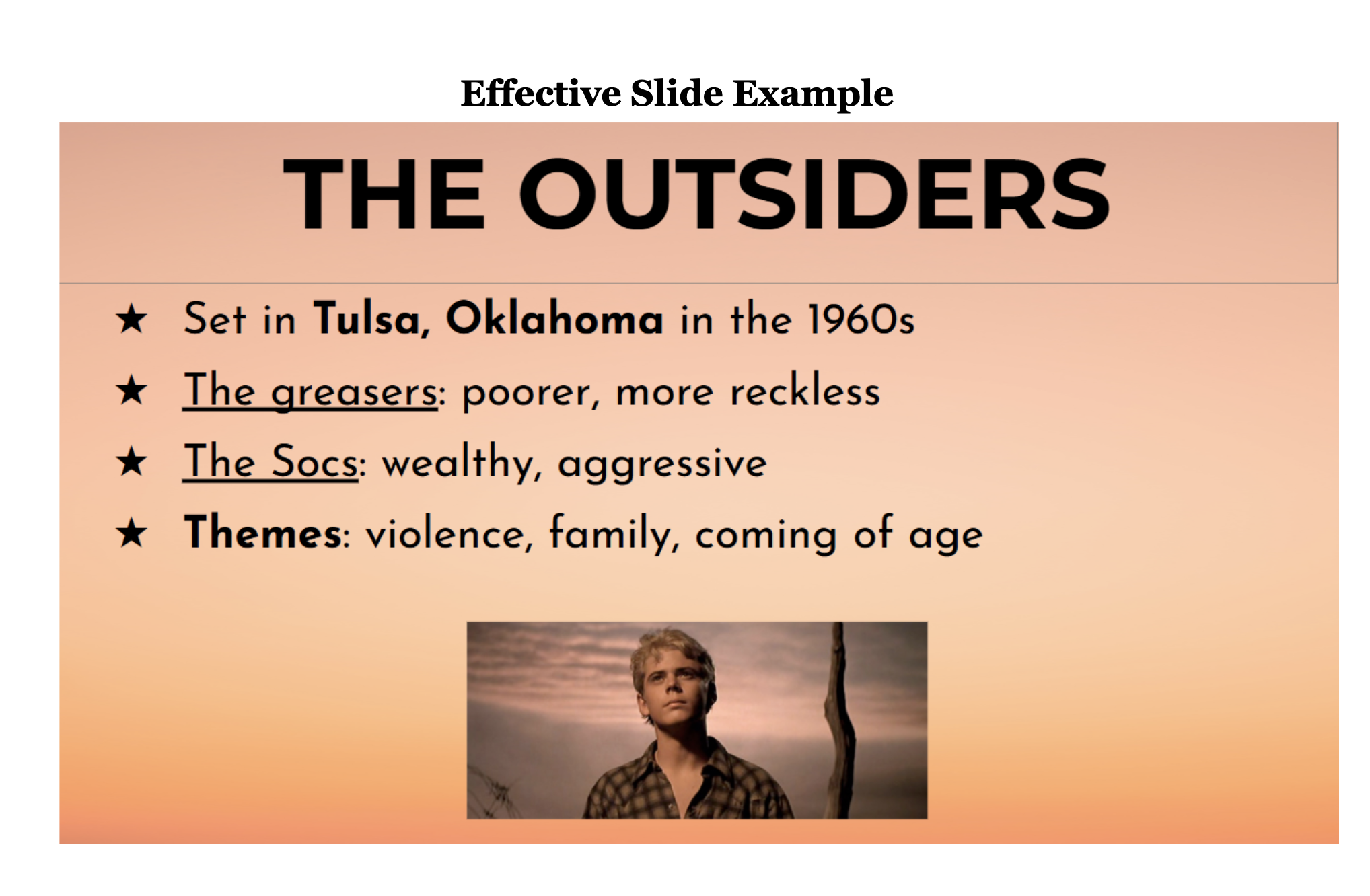
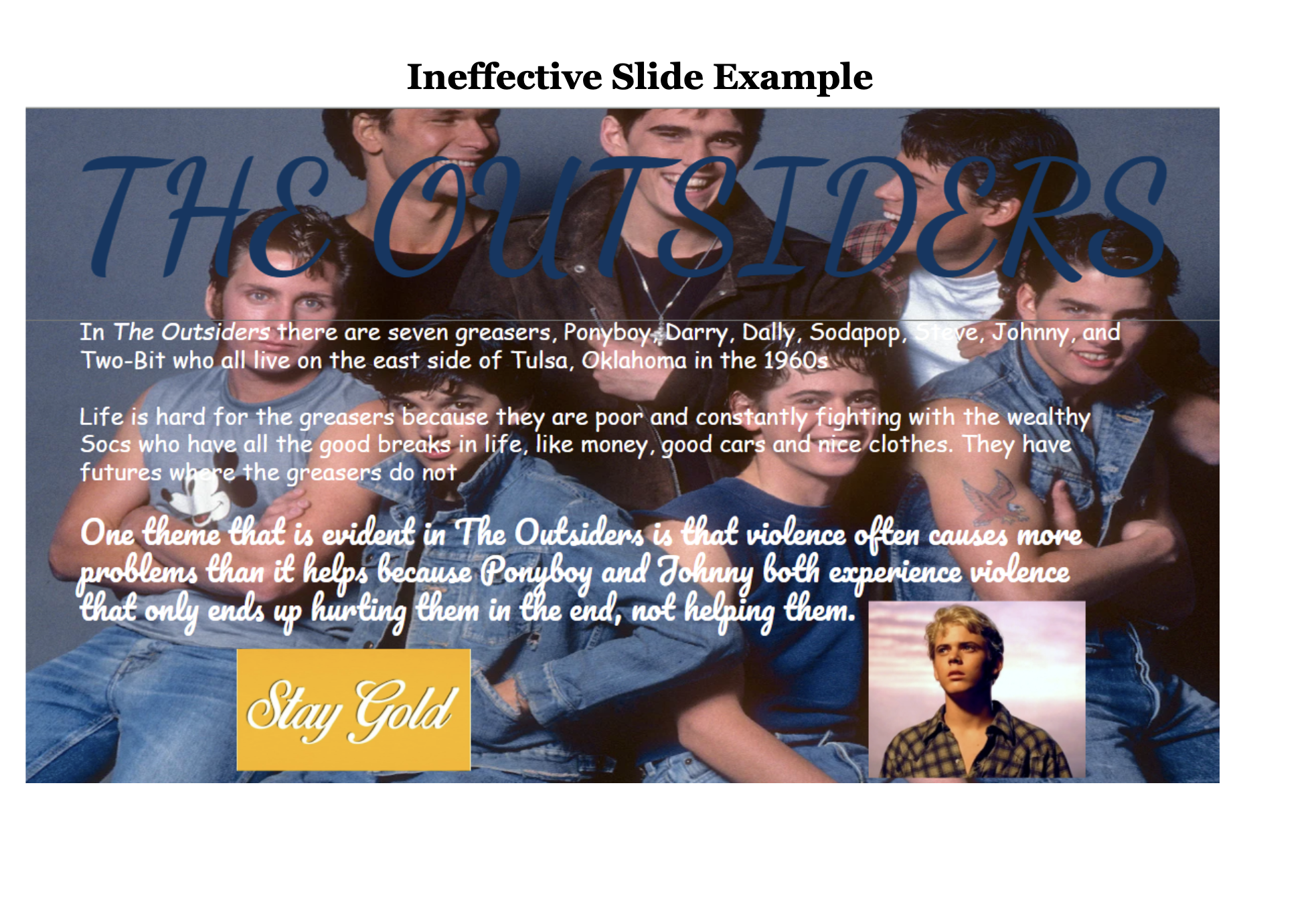
Slides should support your speaking, not replace it. If someone can understand the whole presentation just by reading the screen, the slide probably holds too much information.
Slide Examples
Compare an effective slide with an ineffective one.
Use these examples during class discussion to show how design choices either clarify the message or compete with it.
Slide Text
Keep text to a minimum.
Do
- Keep one main idea on each slide.
- Use bullet points instead of paragraphs.
- Follow the 5x5 rule when possible.
- Stay near 5 bullet points per slide and 5-7 words per bullet.
Avoid
- Putting too many ideas on one slide.
- Using full sentences for every point.
- Placing everything you plan to say on the screen.
- Turning slides into notes that compete with your voice.
Readability
Make slides easy to read.
Do
- Give every slide a clear title.
- Use 1-2 consistent fonts throughout the presentation.
- Keep titles around 36-44 pt and body text around 24-32 pt.
- Use strong contrast between the background and the text.
- Choose sharp, readable fonts like Arial, Calibri, Verdana, Montserrat, Georgia, or Copse.
Avoid
- Slides that feel disorganized or crowded.
- Changing fonts all over the presentation.
- Using text that is too small to read from the back of the room.
- Pairing low-contrast colors like yellow on white or neon on busy backgrounds.
- Using hard-to-read decorative fonts such as Comic Sans, Lobster, Pacifico, or Dancing Script.
Visual Support
Use images and animations correctly.
Do
- Use high-quality images that connect directly to the topic.
- Keep backgrounds simple so the main message stays clear.
- Use animation only when it helps the audience focus.
- Stick to one simple slide transition, such as fade.
- Use sound only very sparingly and only when it truly supports meaning.
Avoid
- Stretching images until they look distorted.
- Using busy image backgrounds.
- Filling slides with random clipart.
- Using flying text or a different transition on every slide.
- Adding distracting sound effects.
Final Review
Take a final look before presenting.
- Does the presentation tell a cohesive story from section to section?
- Is it visually appealing, with fonts and colors that match and read clearly from the back of the room?
- Are there any spelling or grammar mistakes?
- Has any information changed since the slides were first created?
- Do the images feel meaningful, engaging, and connected to the message?
- Are sources cited throughout, including a Works Cited slide?